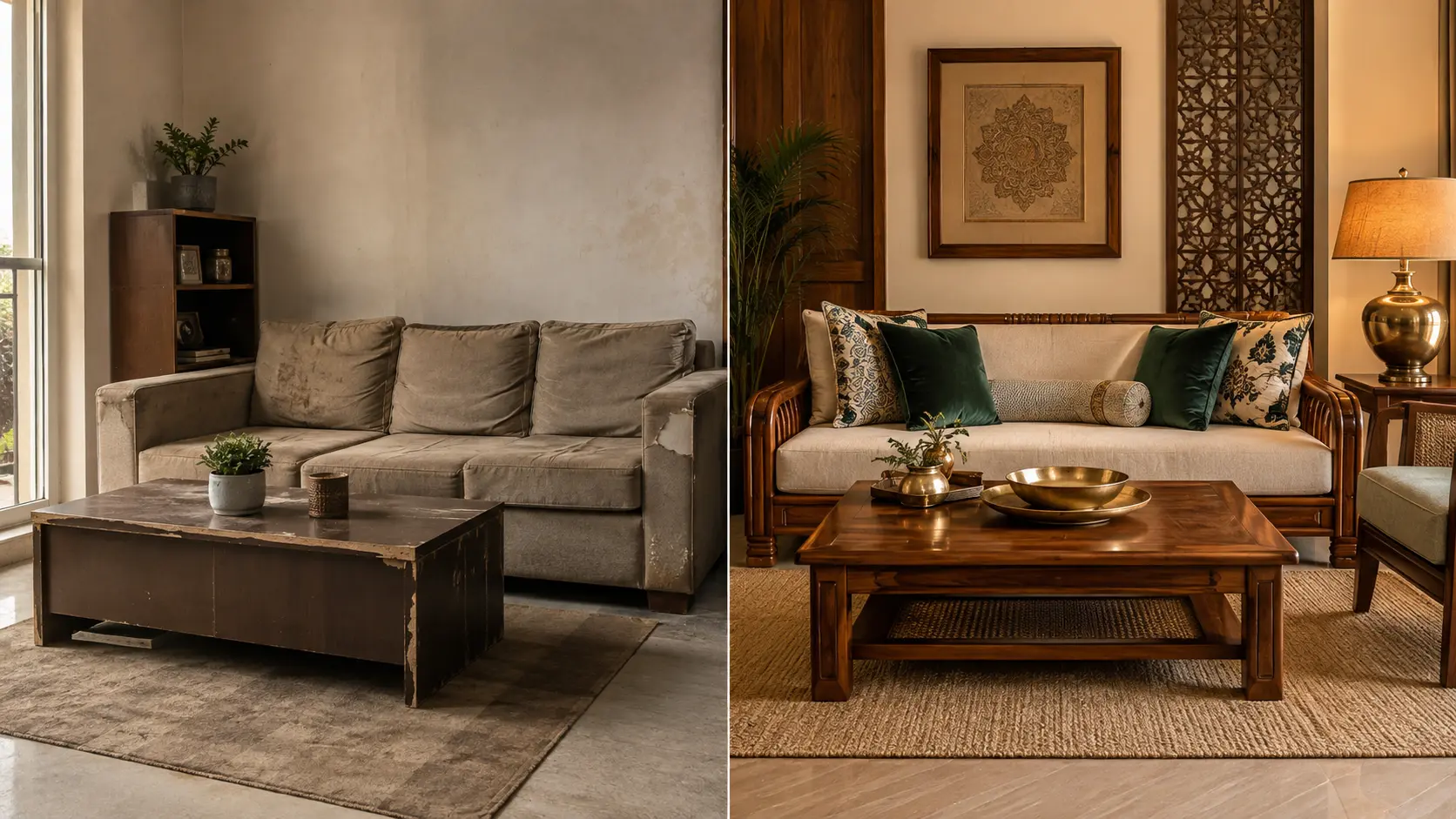
Key Takeaways
- Durability & Materials: Designer furniture uses high-grade hardwoods (like Teak and Sheesham), premium upholstery, and superior joinery that withstands Indian humidity and daily wear far better than mass-produced particle board.
- Long-Term Value: While regular furniture has a lower upfront cost, designer pieces yield a lower total cost of ownership over 10–15 years due to minimal repairs and replacement needs.
- Customisation & Fit: Designer furniture offers tailored dimensions and finishes suited for Indian living spaces, ensuring optimal spatial utility and aesthetic harmony.
Furnishing a home in India is more than just buying chairs and tables; it is a long-term commitment to comfort, aesthetics, and lifestyle. When setting up a living space, every homeowner faces a crucial decision: designer furniture vs regular furniture.
While mass-produced pieces from local markets or flat-pack stores offer an attractive initial price tag, handcrafted designer options promise unmatched elegance, structural integrity, and exclusivity. But is paying a premium for designer furniture truly justified?
According to industry reports by the International Wood Products Association, high-quality solid wood furniture retains over 60% of its structural value after a decade, whereas particle-board alternatives often require replacement within 3 to 5 years. In this guide, we break down the true costs, material differences, and long-term value to help you decide what belongs in your home.
Understanding the Core Differences: Material & Craftsmanship
To evaluate designer furniture vs regular furniture, you must look beneath the veneer. The fundamental difference lies in raw material selection and production standards.
1. Wood Selection and Frame Construction
Regular furniture relies heavily on Medium-Density Fibreboard (MDF), particle board, or commercial-grade plywood held together by basic glues and staples. In contrast, designer furniture in India utilizes kiln-dried Teak wood, Sheesham, Rosewood, or high-density water-resistant (BWR) plywood paired with traditional mortise-and-tenon joinery.
2. Upholstery, Fabrics, and Finishes
Mass-market sofas typically feature standard polyester blends and low-density foam (18–28 D), which flatten within two years. Designer pieces incorporate high-resiliency polyurethane foam (40+ D), feather-down layers, and premium fabrics treated with stain-resistant coatings—crucial for managing dusty Indian urban environments.
Comparison: Designer Furniture vs. Regular Furniture
| Feature | Designer Furniture (e.g., Livoraa Furnishing) | Regular / Mass-Produced Furniture |
| Primary Materials | Solid Hardwood, BWR Plywood, Top-Grain Leather | MDF, Particle Board, Laminate Veneer |
| Lifespan | 15 – 25+ Years | 3 – 7 Years |
| Customisation | Fully Tailored (Dimensions, Fabrics, Polish) | Fixed Sizes and Limited Colors |
| Ergonomics & Comfort | Precision-engineered for spinal support | Standardized, one-size-fits-all cushioning |
| Resale & Aesthetic Value | High retention, timeless appeal | Depreciates rapidly, prone to sagging |
| Environmental Impact | Sustainable timber sourcing, repairable | High turnover, ends up in landfills |
Is Designer Furniture Worth the Investment? Analyzing the Total Cost
When evaluating cost, looking only at the price tag creates a false impression. The true financial metric is the Cost Per Year of Use.
Upfront Cost vs. Long-Term Value
Imagine purchasing a regular 3-seater sofa for ₹25,000. Due to sagging cushions and frame creaking, it requires replacement or heavy repair in 4 years. Over 12 years, you purchase three such sofas, spending ₹75,000+ along with transportation hassle.
Conversely, investing ₹70,000 in a premium designer sofa from Livoraa Furnishing ensures structural stability for 12 to 15 years. You save money, avoid maintenance headaches, and enjoy a luxury seating experience every day.
Climate Suitability in Indian Homes
India’s climate varies from high humidity in coastal cities to extreme temperature swings in interior regions. Regular MDF furniture absorbs atmospheric moisture, leading to swelling, warping, and peeling laminates. Designer pieces undergo rigorous timber seasoning and multi-coat PU sealing to withstand local weather conditions seamlessly.
The Value of Customisation in Luxury Home Decor
Every home has unique layout constraints. Standard off-the-shelf furniture often forces compromises—a coffee table that is slightly too wide, or a dining set that blocks balcony access.
Choosing investment furniture allows complete customisation:
- Spatial Alignment: Tailoring dimensions to fit your apartment floor plan precisely.
- Personalised Style: Selecting textures, metal accents, and wood finishes that match your interior theme.
- Functional Upgrades: Adding hidden storage, modular extensions, or child-safe rounded edges.
Curating cohesive luxury home decor elevates your living space from standard to extraordinary, creating a home that reflects your personality.
Frequently Asked Questions (FAQs)
1. What makes designer furniture so expensive?
Designer furniture costs more due to premium raw materials (such as solid hardwoods and high-density foam), skilled hand-craftsmanship, ergonomic research, and custom manufacturing processes that ensure decades of durability.
2. How can I tell if a piece of furniture is high quality?
Inspect the joints, drawers, and underside. High-quality furniture features dovetail or mortise-and-tenon joints, heavy-gauge hardware, solid back panels, high-resiliency foam, and smooth, even finishes across all hidden surfaces.
3. Does designer furniture hold its resale value?
Yes. Solid wood and authentic designer pieces retain significant structural and aesthetic value over time. Unlike particle-board items, solid wood furniture can be sanded, polished, and re-upholstered to restore its original beauty.
4. How long should a good quality sofa last in India?
A well-constructed designer sofa built with solid wood frames and high-density foam lasts between 12 to 20 years with basic maintenance, whereas standard mass-produced sofas generally degrade within 3 to 5 years.
5. Why is particle board furniture not recommended for humid climates?
Particle board consists of compressed wood chips bonded with glue. In humid Indian weather, moisture penetrates the seams, causing the material to expand, crack, and lose structural integrity permanently.
Conclusion: Making the Right Choice for Your Home
When weighing designer furniture vs regular furniture, the decision comes down to your long-term goals. If you need temporary, low-cost fixtures for a short stay, regular furniture serves a purpose. However, if you are building a sanctuary designed to last, investing in handcrafted, durable pieces yields far greater satisfaction and financial efficiency over time.
Your home deserves furniture that balances timeless aesthetics with uncompromised strength. Explore curated collections, bespoke designs, and artisan craft to transform your space into a masterpiece.
Ready to elevate your living space with furniture designed for a lifetime?
Visit Livoraa Furnishing today to discover premium, tailor-made furniture crafted for modern Indian homes.